Tekton Design Encore Loudspeaker

An Instant Classic!
 Tekton Design’s wunderkind, Eric Alexander, has generated considerable buzz over the past five years with a series of exceptional yet affordable loudspeakers. My first audition was less than a year ago when I reviewed the Double Impact speaker (reviewed here). With its $3,000 asking price, it catapulted Alexander into iconic status. Not since Albert von Schweikert introduced his VR-4 in 1993 has a loudspeaker been so well received by so many music lovers with such a minimal monetary outlay. As of this review, Stereo Times writers Dave Abramson, Frank Alles, Mike Wright, Mike Girardi, Ron Cook, Greg Voth, Ed Van Winkle, Moreno Mitchell, and I use Tekton loudspeakers in our reference systems.
This situation, dear reader, is unprecedented in our magazine’s 20-year history! I have never heard the systems of Dave Abramson, Frank Alles, Mike Girardi, Mike Wright, Ron Cook, or Moreno Mitchell; yet, these writers have all come to the same conclusion as I have: Tekton loudspeakers are very special.
If you peruse my review of the Double Impacts, you will discover that it’s the midrange that ultimately won me over. I am told it is Alexander’s proprietary coax driver, composed of seven tweeters, that produces that midrange magic.
Some months later, I was sent a pair of Double Impact SEs. They took a long time to bowl me over; their refined upper frequencies and relaxed presentation left me wanting. As I told Eric, “The SE’s are obviously better, but at the same time, they’re also less exciting in my listening space. With time and plenty of burn-in, they become more lively and dynamic for sure. However, those standard Double Impacts impressed the heck out of me with their ability to relay delicacy and space simultaneously against a huge and tightly-focused soundstage.”
When he mentioned a successor to the Double Impact SE called the Encore, I was somewhat wary of auditioning it. Alexander insisted, and some months later, a review sample arrived.
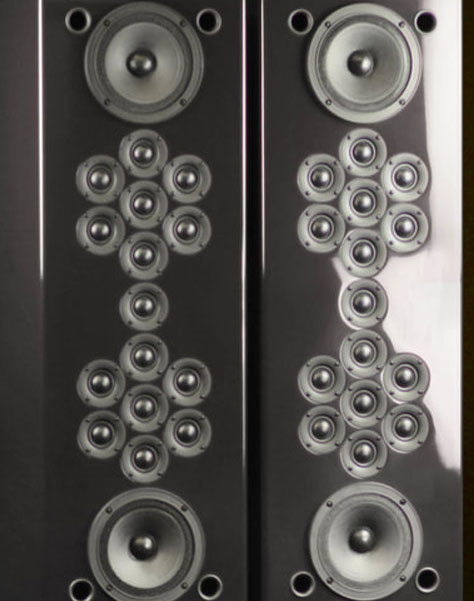
The Encore stands 62″ tall, 8″ higher than the Double Impacts. The Encore is also much heavier (175 lbs vs. 118 lbs). They arrived very well packaged, and once I managed to get them free of their boxes, I saw that Alexander had designed the Encores around fifteen (proprietary) MTM dome tweeters. This “grouping” of tweeters in Alexander’s patented design acoustically constitutes two midrange drivers. An additional MTM dome, located between these groups, serves as the single high-frequency driver. Pairs of ScanSpeak 6.5″ mid-bass drivers are located above and below the midrange/tweeter array. There are four small ports alongside each mid-bass driver. Finally, a pair of long-throw, 11″ woofers completes the Encore assembly:19 individual drivers!
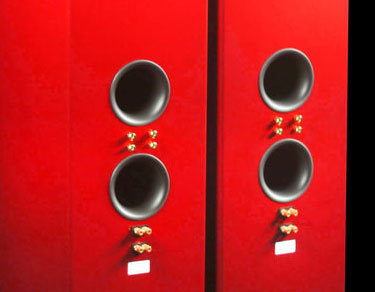
The rear of the Encores has two pairs of Cardas 5-way binding posts for bi-wiring (not bi-amping—ask Alexander why). There is an additional pair of resistor pots located right above the speaker terminals, designed to tune out frequency imbalances due to system and/or acoustic (room) issues.
Tekton Revolution
A strong sense of coherence is evident in all of Alexander’s designs. Still, I think the Encores may excel every previous model (excluding the Ulfberht) in terms of three-dimensionality, focus, and coherency. Stepping back and looking at this loudspeaker had me wondering aloud, How does he do it? How does he make all those drivers, with their inherent acoustical anomalies and conflicts, behave as a single unit?
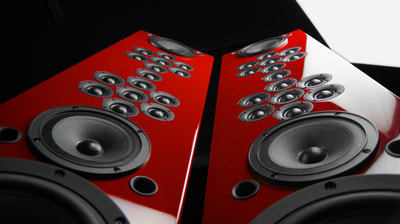

Here’s how. The Encore and Ulfberht, being large multi-driver configurations, enable Eric Alexander to demonstrate his technology more effectively. The Tekton story is a technological success story first and foremost, and a loudspeaker success story second. What is exciting about Tekton Design is its creative head designer, Eric Alexander, and his applied patents, as well as his unusual and uncanny approach to avoiding the pitfalls that plague conventional designs. In the Encore, for example, you see more individual drivers but hear far less distortion as well as remarkable coherence.
 As acclimated as I had become to the Double Impact SE’s after nearly of year of listening, I was not prepared for the Encore’s superior impact, dynamic expression and incredible lack of distortion. The ability of images to pop out of nowhere, instruments locked in a vast soundstage, the accuracy of timbre, and the intimacy had me almost giddy with delight. This created an eagerness to pull out songs that I haven’t played in years. And in each case, the results were nearly identical: the absolute lack of grit, glare, and grain stood out like never before. This gave each song an added sense of resolution, vitality, and density. Voices, compliments of the Encore’s remarkably designed midrange, offer up a clarity that allows the music to pour out from a place that is both more emotionally rich and heartfelt.
There are a few fellow Tekton owners nearby, and they were quite excited to hear this newest design from Eric Alexander. They were as excited as I was at the sound quality. Especially at the ability of the Encore to present bass in a way that belies its size. Yet, the Encores produced exceptionally clean, deep bass in a room that hadn’t previously seemed capable of it. The rated efficiency is 96dB with a 4-ohm load. Indeed, to my ear, the 96dB Encores sound far more efficient than the 98dB DI SEs, using the same 37-watt Essenza integrated amplifier from Grandinote of Italy (and Hemingway cables).
The Tekton Encore loudspeaker is not merely another step forward or an upgraded version of the Double Impact loudspeaker. In my opinion, and despite any similarities, the Encore is an entirely different concept altogether. They sound like no loudspeaker I’ve had in my dining room. They’re quick and nimble, yet powerfully alert in the bass region without bloat or blunder. Their midrange is unusually natural, much like that of a fine ribbon loudspeaker. All the drivers are located right on the front baffle, where you can see them, yet they emit sound as though there are additional drivers on their periphery. Image density and incredibly low noise give them an almost eerie sense of quiet.
Last but not least is their asking price. These puppies retail for $8,500, which is quite expensive in typical Tekton terms; yet, they’re quite simply the best-sounding loudspeakers I’ve heard in a very long time. In my opinion, they’ll stand up handsomely against speakers in the $50,000 to $100,000 range. Don’t blame me for being smitten. I just happen to think they’re that incredible. Happy listening!

clement perry
Specifications:
Price: $8,500.00/pr USA
Made under U.S. Patent 9247339 with multiple new patents pending
Proprietary loudspeaker design
Ultra-linear frequency response with ±.5dB deviation from 70Hz-20kHz
One single crossover element placed within the tweeter path
Ultra-linear, entirely time-invariant minimum-phase mid-range section
Proprietary patent pending 15 dome radiating hybrid MTM high frequency array
Two 6.5″ mid-bass patented ‘overtone & harmonic’ transducers – of Italian origin
Dual 11″ low-frequency transducers
96dB 2.83V@1m sensitivity
4 Ohm design for optimum performance
20Hz-30kHz frequency response
Dimensions Width 13.25″ x Depth 15.25″ x Height 62″
800 Watt power handling
Weight 175 lbs